BrilloBrilliance
La luz blanca que el diamante te devuelve, reflejada por dentro y por fuera.34
The white light the diamond returns to you, reflected from inside and out.34
Centro de educaciónEducation Center
Un certificado describe un diamante. Nosotros queremos ver cómo se comporta con la luz. Estas son las herramientas que usamos y lo que cada una nos cuenta.
A lab report describes a diamond. We want to see what it does with light. These are the tools we use and what each one tells us.
El principioThe principle
Cuando podemos elegir, preferimos lo que se mide: el ángulo real de cada faceta, la luz tal como se ve en video, el propio diamante sobre fondo negro. Y no mezclamos formas: un oval se compara con ovales; una esmeralda, con esmeraldas.
Whenever we can, we rely on what can be measured: the actual angle of every facet, light as it looks on video, the diamond itself against a black background. And we don’t mix shapes: an oval is compared with other ovals, an emerald cut with other emerald cuts.
Por dónde empezamosWhere we start
Cada diamante llega con el certificado de su laboratorio. Cuando es GCAL, buscamos el grado 8X en las formas que esa escala evalúa. El 8X exige Excellent en ocho criterios: siete van del pulido a la simetría óptica, y el octavo es corazones y flechas en los redondos y la estética de la silueta en las demás formas.12 Es una buena base, pero solo eso. A la esmeralda, al Asscher y al corazón, que quedan fuera del 8X, les aplicamos el mismo control de la luz.
Every diamond comes with its lab report. When that lab is GCAL, we look for the 8X grade in the shapes that scale covers. The 8X grade requires Excellent on eight criteria: seven run from polish to optical symmetry, and the eighth is hearts and arrows for rounds and shape aesthetics for fancy shapes.12 It’s a solid foundation, but only a foundation. Emerald-cut, Asscher and heart diamonds, which 8X doesn’t cover, go through the same light checks as every other shape.
La luz blanca que el diamante te devuelve, reflejada por dentro y por fuera.34
The white light the diamond returns to you, reflected from inside and out.34
La luz que se descompone en los colores del arcoíris.3
White light split into the colors of the rainbow.3
Los destellos y el juego de zonas claras y oscuras que ves al moverlo.3
The sparkle and the pattern of light and dark areas you see when it moves.3
La regularidad con que se repite el dibujo de luz cuando miras el diamante de frente.5
How evenly the pattern of light repeats when you look at the diamond face up.5
Un escáner reconstruye el diamante en tres dimensiones y registra el ángulo y la orientación de cada faceta. Es su geometría completa, no una aproximación a partir de unas pocas medidas. Sobre un modelo así se pueden trazar rayos de luz y calcular cómo entran y salen, de frente y con el diamante inclinado.4
A scanner rebuilds the diamond in three dimensions and records the angle and orientation of every facet. It’s the diamond’s full geometry, not an approximation from a handful of measurements. On a model like this, you can trace rays of light and see how they enter and leave, face up and with the diamond tilted.4
Un ejemplo: dos diamantes pueden tener las mismas proporciones medias y, sin embargo, en uno de ellos algunas facetas no coinciden con sus vecinas. Las cifras resumidas lo esconden; el modelo 3D lo muestra.
For example, two diamonds can have the same average proportions, yet in one of them a few facets don’t line up with their neighbors. Summary figures hide that; the 3D model shows it.
Medida 3D3D measurement
Un certificado habitual resume el corte en unas pocas cifras. Algunas cifras son promedios: el ángulo de pabellón, por ejemplo, resume las ocho facetas principales del pabellón.6 Esa cifra dice mucho, pero no si las ocho son iguales entre sí.
A standard lab report sums up the cut in a few figures. Some of them are averages: the pavilion angle, for instance, is the average angle of the main pavilion facets.6 An average tells you a lot, but not whether all eight facets match one another.
Así se ve un informe de medición como los que revisamos. Fíjate en la tabla de ángulos por sector: no hay un solo ángulo de corona, sino ocho.
Here’s an example of the kind of measurement report we review. Look at the table of angles by sector: there are eight crown angles, not one.
Ejemplo ilustrativoIllustrative example
Informe de medición 3D3D measurement report
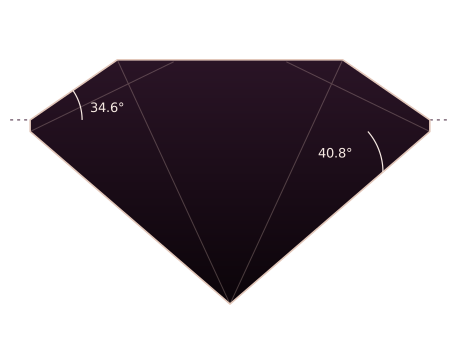
Perfil medido, a escalaMeasured profile, to scale
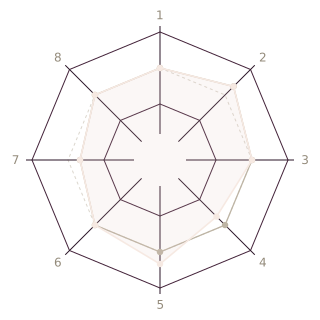
Diferencias entre sectores: desviación de cada sector respecto del promedio (cada anillo, 0.3°)Differences between sectors: how far each sector is from the average (each ring, 0.3°)
| PartePart | 1 | 2 | 3 | 4 | 5 | 6 | 7 | 8 | Prom.Avg. |
|---|---|---|---|---|---|---|---|---|---|
| CoronaCrown | 34.6 | 34.7 | 34.6 | 34.5 | 34.7 | 34.6 | 34.5 | 34.6 | 34.6 |
| PabellónPavilion | 40.8 | 40.9 | 40.8 | 40.8 | 40.8 | 40.8 | 40.7 | 40.8 | 40.8 |
Informe 3D realActual 3D report
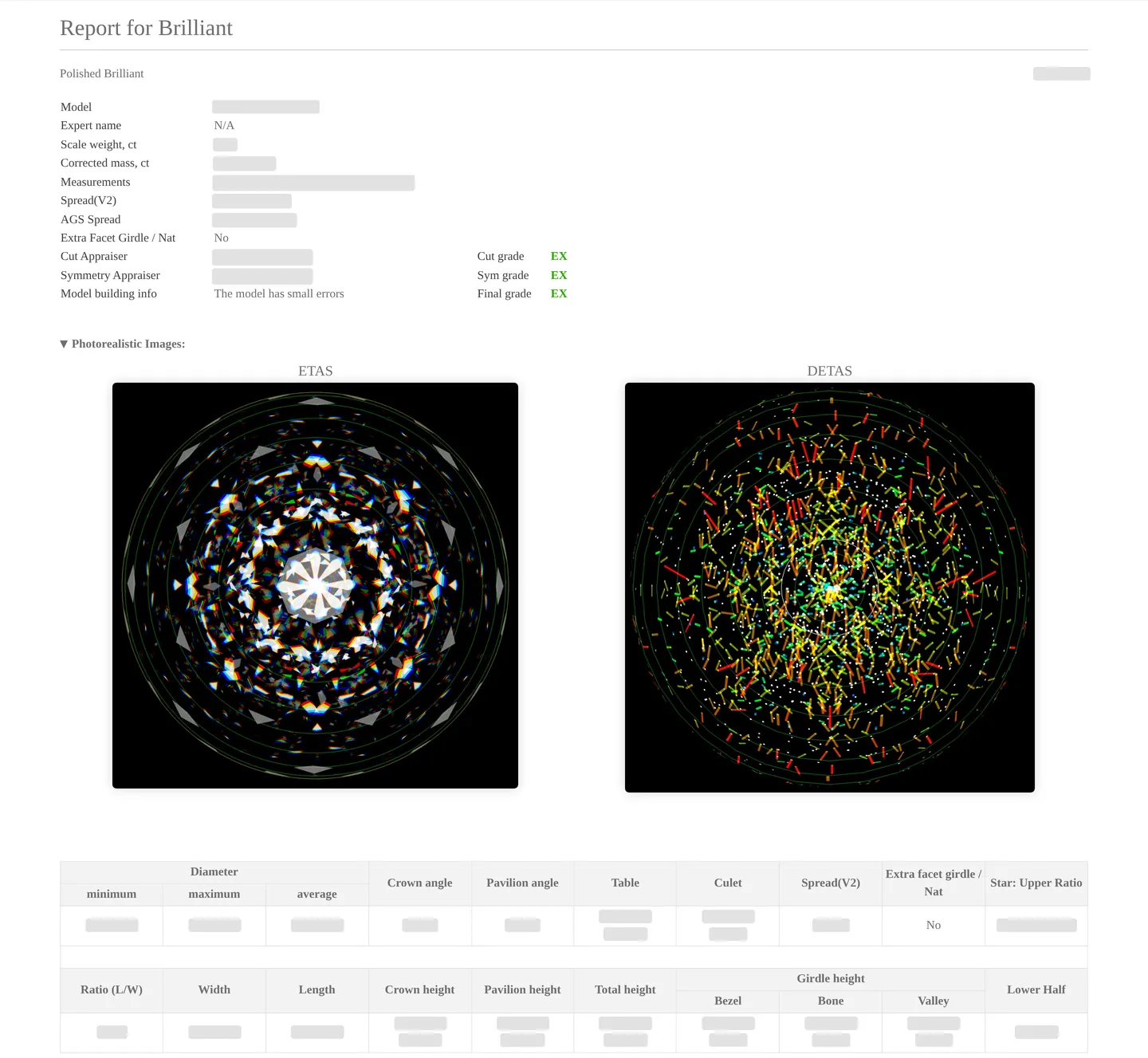
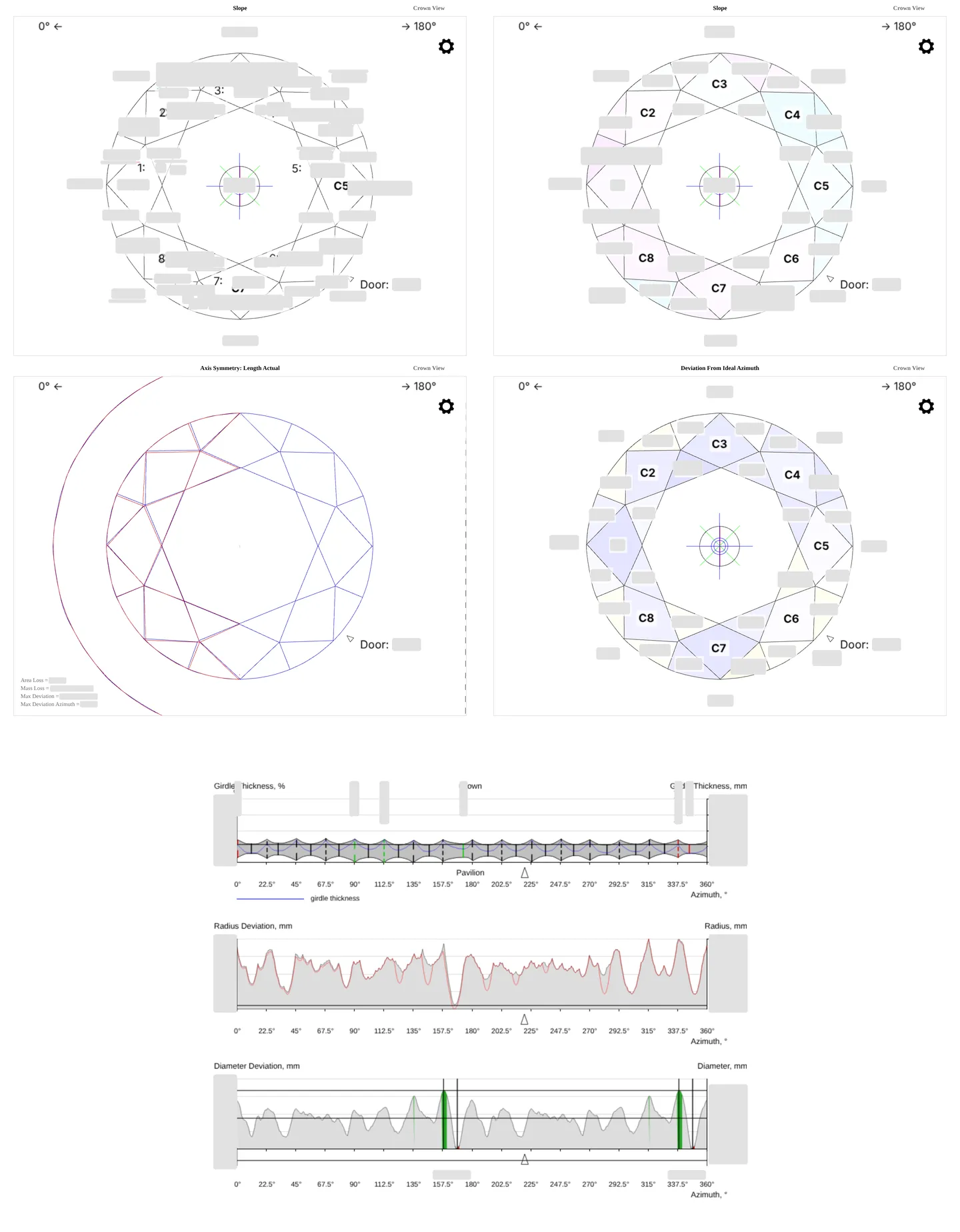
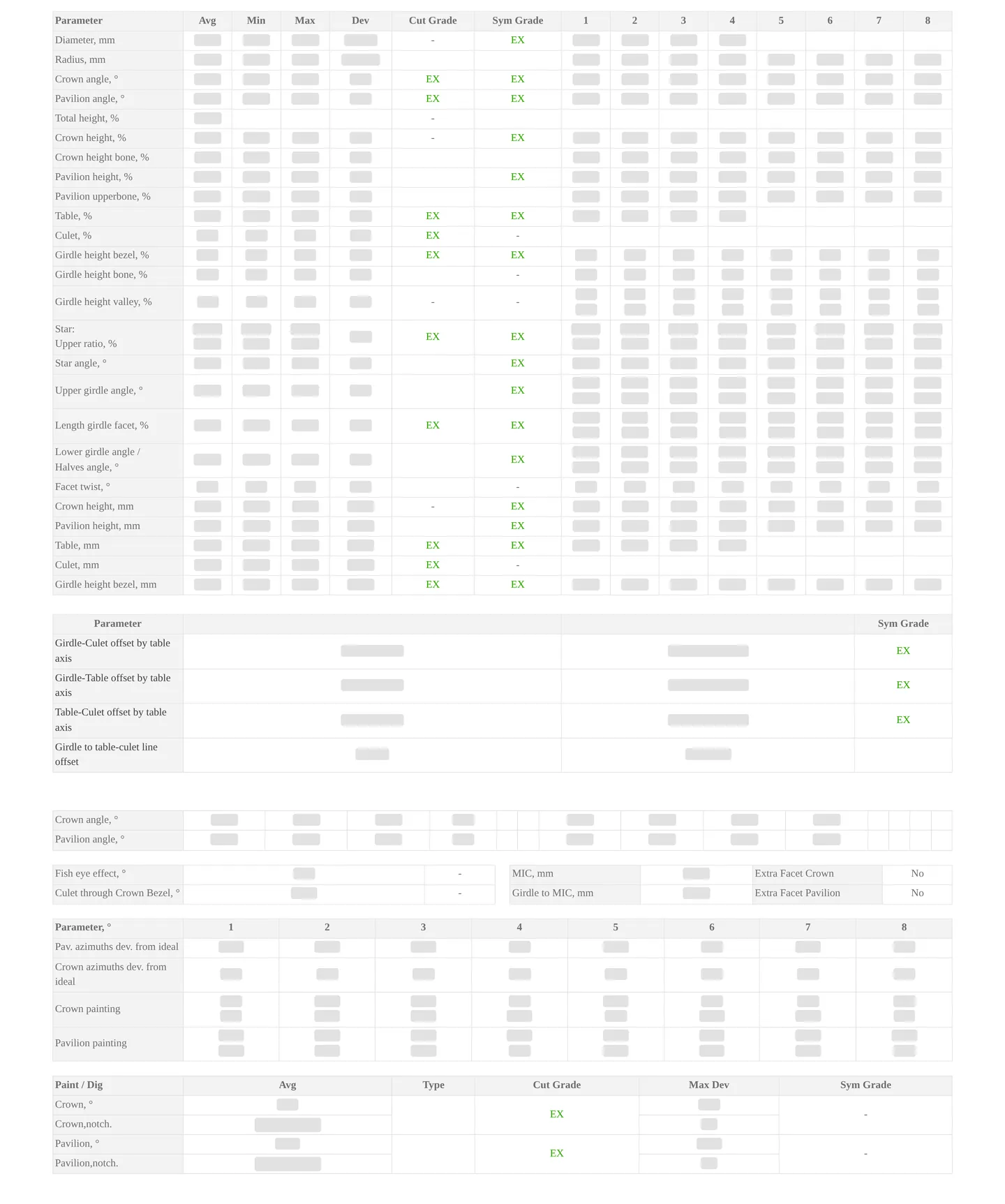
Del modelo 3D sale un informe de varias páginas, el i3d: las proporciones medidas de cada faceta, las desviaciones de simetría sector por sector y simulaciones de la luz como ETAS y DETAS. Ocultamos las cifras: aquí importa ver cuánto detalle contiene.
The 3D model produces a report several pages long, the i3d: the measured proportions of every facet, symmetry deviations sector by sector, and light simulations such as ETAS and DETAS. We’ve hidden the figures; what matters here is how much detail it holds.
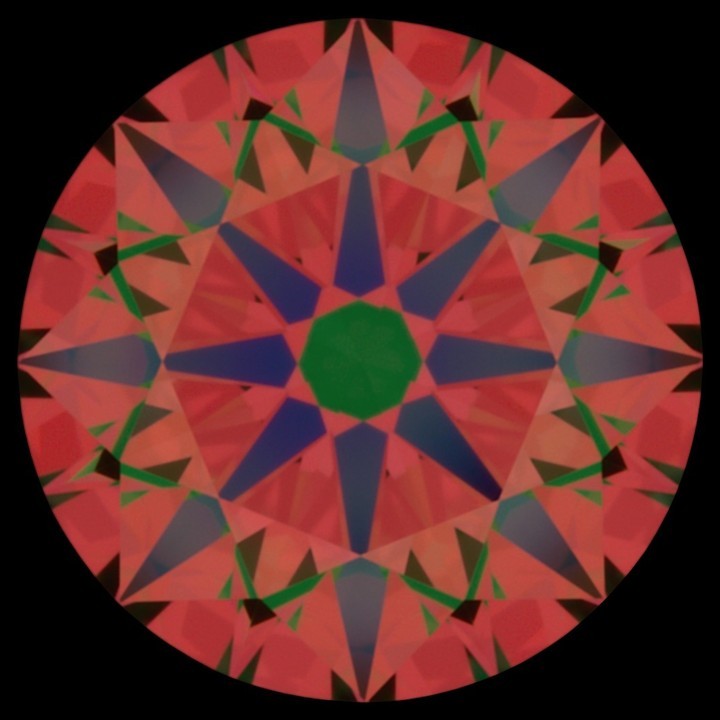
ASET (Angular Spectrum Evaluation Tool) es una herramienta de la American Gem Society (AGS). Muestra desde qué ángulos recoge la luz el diamante y pinta el resultado en cuatro colores.4
ASET (Angular Spectrum Evaluation Tool) was developed by the American Gem Society (AGS). It traces rays of light through a 3D scan of the diamond and paints the result in four colors.4
Un buen mapa tiene mucho rojo, algo de verde, poco gris y un azul bien repartido.4 No hay dos iguales: cada mapa es como la huella digital del diamante.74
A good map has plenty of red, little green and gray, and well-distributed blue.4 No two maps are alike; each one is a fingerprint of its diamond.74
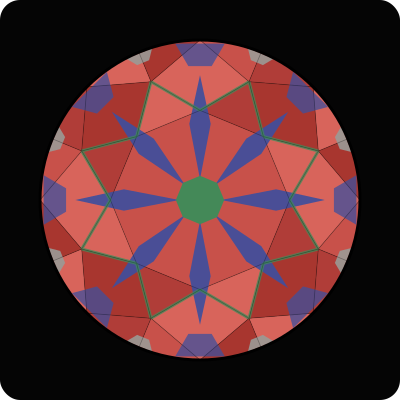
ETAS (Effective Total Angular Size) es un valor que se obtiene por simulación en computadora: indica qué parte del espacio que rodea al diamante puede ver un observador a través de él.8 Es una medida óptica que no depende de ninguna iluminación ni de ningún punto de vista en particular.8
ETAS (Effective Total Angular Size) is a value obtained by computer simulation: it measures how much of the space around the diamond an observer can see through it.8 It’s an optical measure that doesn’t depend on any particular lighting or viewpoint.8
DETAS (Dynamic ETAS) se calcula de la misma manera, pero con el diamante en movimiento: suma los recorridos que hacen los puntos de luz de la simulación mientras el diamante se inclina ligeramente.8 En otras palabras: ETAS describe el diamante quieto; DETAS, el diamante en movimiento.
DETAS (Dynamic ETAS) is calculated the same way, but with the diamond in motion: it adds up the paths traced by the simulation’s points of light as the diamond tilts slightly.8 In other words: ETAS describes the diamond at rest; DETAS, the diamond in motion.
Los dos valores se expresan en relación con un brillante redondo de proporciones Tolkowsky, simulado en las mismas condiciones: un valor más alto que el de esa referencia indica que el diamante la supera en ese cálculo.8
Both values are expressed relative to a round brilliant with Tolkowsky proportions, modeled under the same conditions: a value higher than the reference’s means the diamond exceeds it on this measure.8
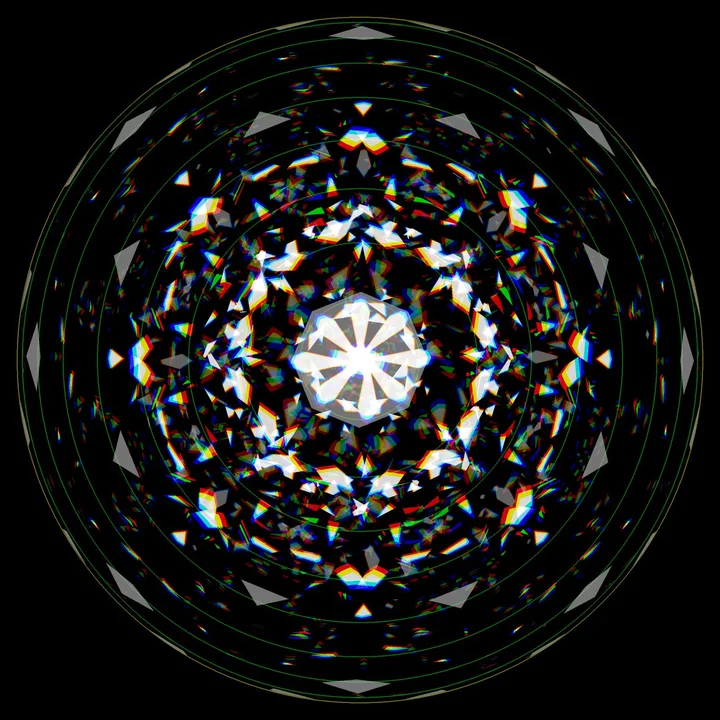
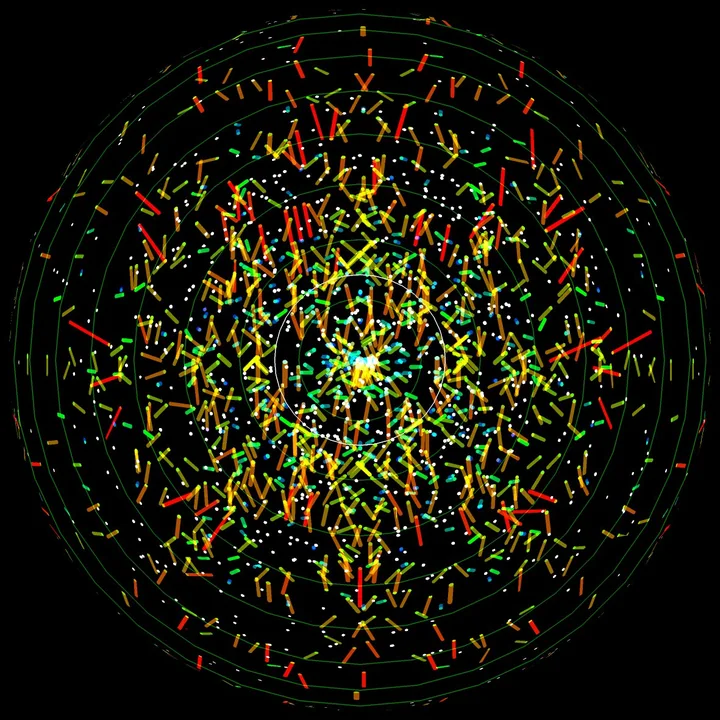
Imágenes ETAS y DETAS tal como aparecen en el informe 3D real de arriba.ETAS and DETAS images as they appear in the actual 3D report above.
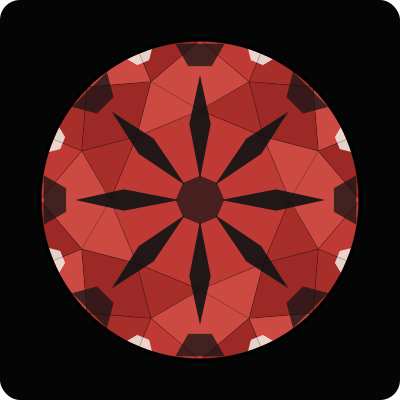
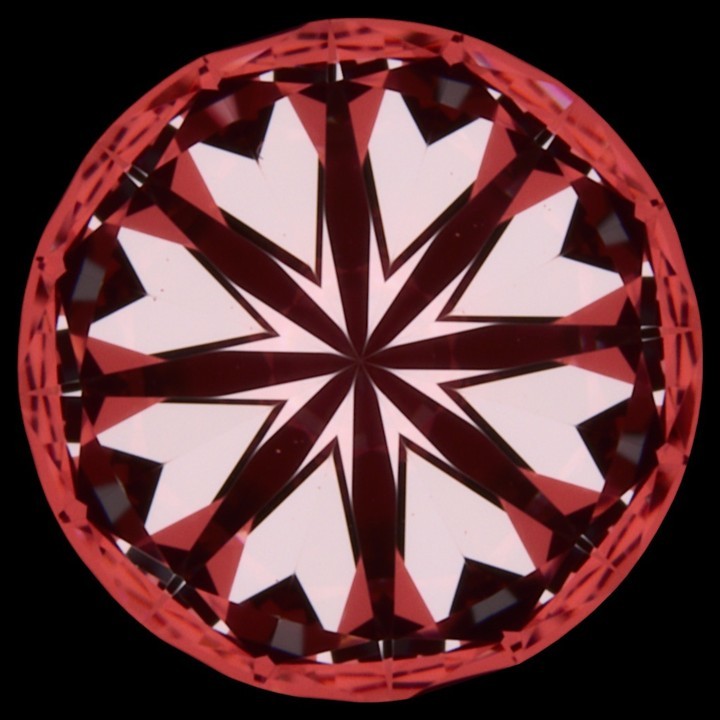
Es un visor con un reflector rojo. Las zonas rojas son la luz más intensa que vuelve a tus ojos; las blancas, la que se escapa por el pabellón; las negras, la que llega desde ángulos muy altos.9 Es uno de los métodos más sencillos y sirve para detectar fugas de luz de un vistazo; el ASET da más detalle.9
It’s a viewer with a red reflector. Red areas are the strongest light coming back to your eye; white areas are light leaking out through the pavilion; black areas are light arriving from very high angles.9 It’s one of the simplest methods and good for spotting light leakage at a glance; ASET gives more detail.9
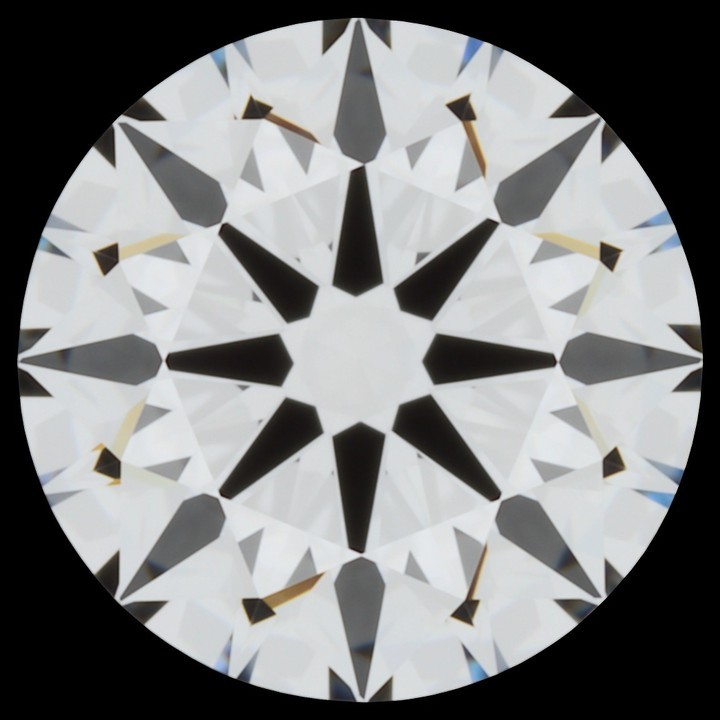
En un redondo tallado con precisión, un visor especial revela ocho flechas al mirarlo desde arriba y ocho corazones al darle la vuelta.5 Cuanto más parejos, mejor alineadas están las facetas. No existe un estándar único: cada laboratorio y cada vendedor aplica sus criterios.1011 Por eso, en los redondos, miramos nosotros mismos qué tan precisos son.
In a precisely cut round, a special viewer reveals eight arrows from the top and eight hearts from the bottom.5 The more even they are, the better aligned the facets. There’s no single standard; each lab and seller applies its own criteria.1011 So with rounds, we check their precision ourselves.
El brillo se aprecia mejor con luz difusa, y el fuego, bajo luces puntuales.12 Por eso vemos cada diamante en video, girando, con las dos: una luz suave, como la de una oficina, que muestra cómo se verá en tu día a día, y luces puntuales, para ver su fuego.
Brilliance shows best in diffused light, and fire under spotlights.12 So we film and measure each diamond as it turns on video in both: soft office light, close to how it will look day to day, and spotlights that bring out its fire.
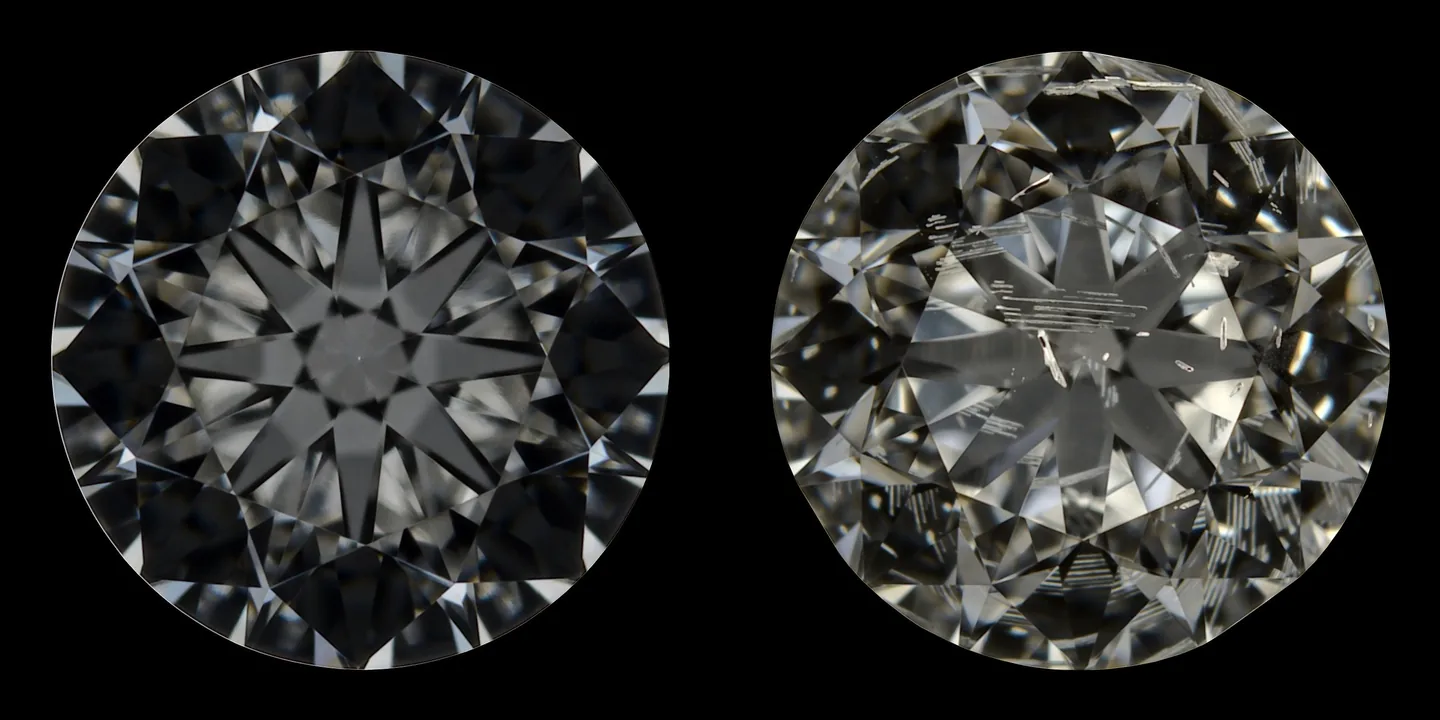
Dos diamantes de laboratorio redondos, filmados lado a lado con la misma cámara y la misma iluminación: a la izquierda, uno de 1.77 ct, H, VVS2, con un corte excepcional; a la derecha, uno de 1.72 ct, H, VS1, con uno de los peores cortes que encontramos para comparar. En el de la derecha, fíjate en la estrella oscura del centro: ahí el diamante apenas devuelve luz a tus ojos.
Two round lab-grown diamonds, filmed side by side with the same camera and lighting: on the left, a 1.77 ct, H, VVS2 diamond with an exceptional cut; on the right, a 1.72 ct, H, VS1 diamond with one of the poorest cuts we could find for comparison. In the diamond on the right, notice the dark star at the center: that’s where it returns little light to your eyes.
Ninguno de los dos es un diamante que venderíamos: trabajamos solo con D, E y F.
Neither is a diamond we’d sell: we work only with D, E and F.
Dos diamantes pueden parecerse sobre el papel y verse muy distintos en persona. Por eso miramos cada diamante en video antes de mostrártelo.
Two diamonds can look alike on paper and very different in person. That’s why we watch every diamond on video before we show it to you.
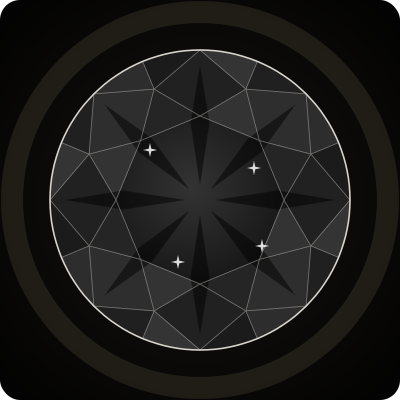
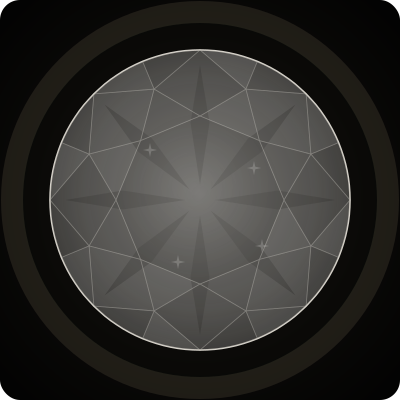
En el darkfield, o campo oscuro, el diamante se ilumina sobre un fondo negro, y lo que dispersa la luz en su interior resalta contra la oscuridad.13 Los gemólogos usan esta iluminación desde hace décadas para estudiar las inclusiones.14
In darkfield, the diamond is lit against a black background, so anything inside it that scatters light stands out.13 Gemologists have used this kind of lighting for decades to study inclusions.14
Nosotros la usamos para algo muy concreto: encontrar diamantes con velo. Algunos tienen partículas diminutas que, juntas, dispersan la luz y les dan un aspecto turbio o lechoso.1516 Sobre fondo negro, ese velo se nota. Cuando lo vemos, el diamante queda fuera, por bueno que sea su certificado.
We use it for something very specific: finding hazy diamonds. Some contain tiny particles that, together, scatter light and give a cloudy or milky look.1516 In darkfield, that haze can’t hide. When we spot it, the diamond is out, however good its report.
Dos diamantes de peso parecido, en los dos extremosTwo diamonds of similar weight, at opposite extremes
Dos diamantes del mismo peso pueden parecer de distinto tamaño, según cómo se reparta ese peso.1718 Si la corona y el pabellón están demasiado inclinados, el diamante gana profundidad y su diámetro queda por debajo de lo que su peso haría esperar.17 Por eso miramos cuánta superficie ofrece cada diamante de frente.
Two diamonds of the same weight can look different in size, depending on how that weight is distributed.1718 When the crown and pavilion are too steep, the diamond gains depth, and its diameter ends up smaller than its weight would suggest.17 So we look at how much surface each diamond shows face up.
Pedimos pulido Excellent y fluorescencia nula.
We require Excellent polish and no fluorescence.
Con todo esto delante, comparamos cada diamante con los demás de su forma y te mostramos solo los que quedan en lo más alto. Si ninguno lo consigue, no te proponemos nada y seguimos buscando.
With all of this in hand, we compare each diamond with others of its shape and show you only the ones at the top. If none make it, we don’t send you anything; we keep looking.